Saved and frozen searches
Save a query, or a set of terms to highlight, and use it again later. Freeze a query’s results to keep the same documents, counts, and filters while the vault changes underneath.
Docbank is a document vault that runs on your own machine. It imports files, email, photos, and recordings, makes their text searchable, and keeps every version you save. You and your agents search, review, and export the same records.
curl -fsSL https://docbank.ai/install.sh | sh
macOS and Linux · Windows install
The local web app shows the vault as folders. Open a document to read it, see its earlier versions, and check where it came from. Select several documents to tag them together or download the list as CSV.

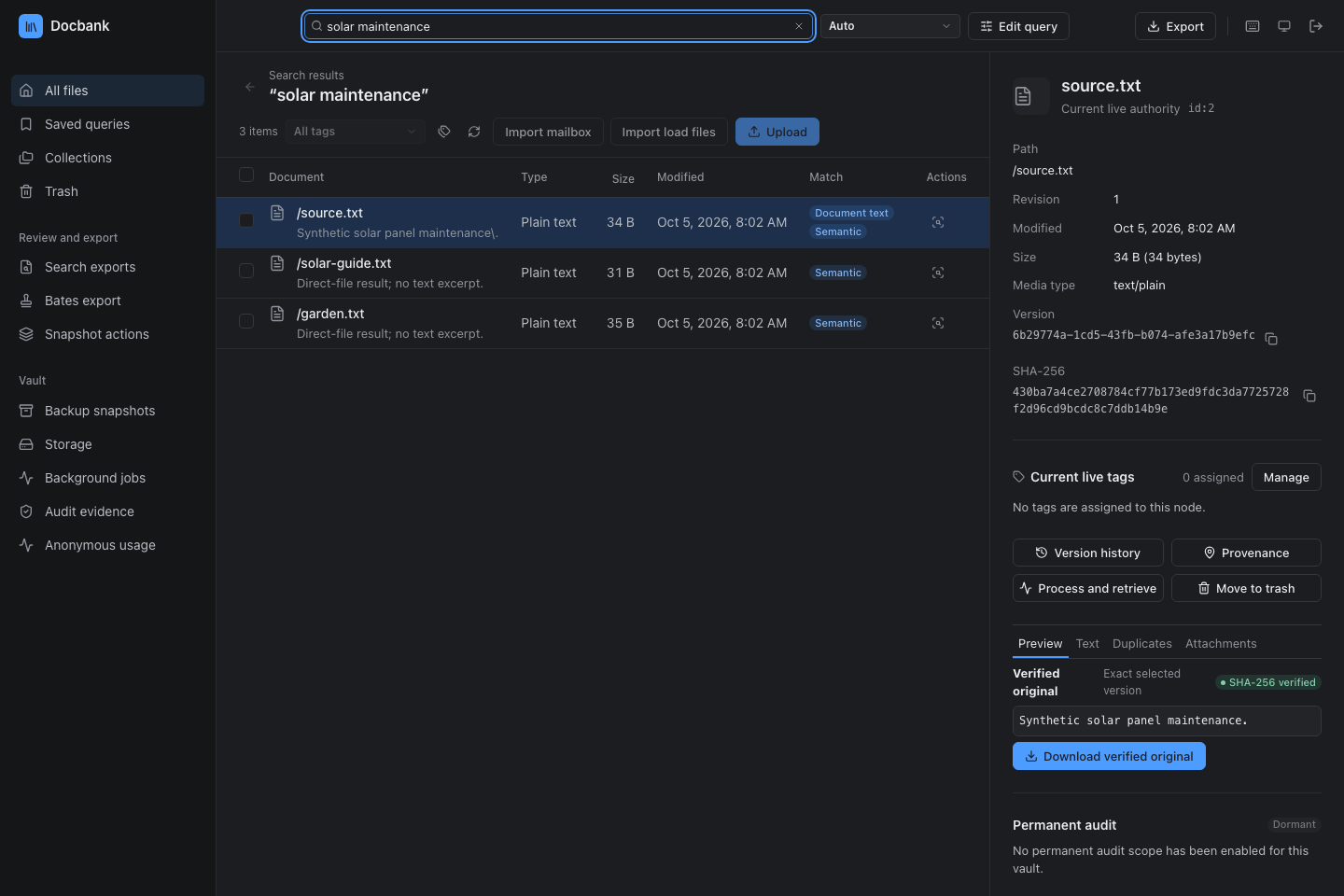
Search covers file names and the text Docbank extracts from each document. Narrow the results by folder, tag, file type, or date. Connect an embedding service to search by meaning as well. Results show the text that matched, so you can check it against the original.
Save a query, or a set of terms to highlight, and use it again later. Freeze a query’s results to keep the same documents, counts, and filters while the vault changes underneath.
Pick a file and Docbank ranks the others in the current view by similarity. It compares embeddings already stored in the vault and sends nothing to a provider.
Import an MBOX file or a Google Takeout archive. Read each message as HTML or plain text, look at its headers, and move between a message and its attachments.
Import a transcript, or have a Docling service you configure transcribe WAV and MP3 audio. Search results can point to the part of the recording that matched.
Search and filter documents · Configure search by meaning · Group and browse photos
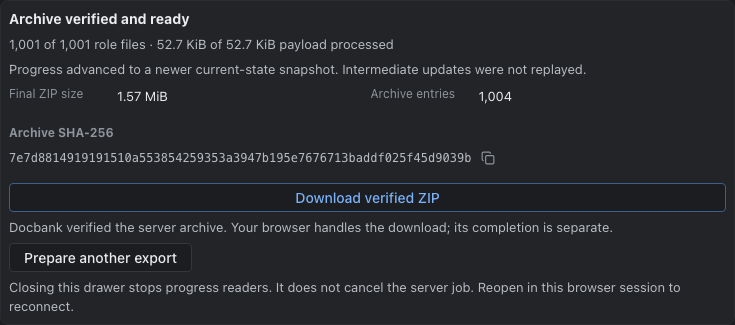
Docbank shows what an export will contain before it builds anything. The export uses the versions you selected, even if those documents change afterwards, and Docbank verifies every file it puts in the download.
Download the selected originals as one ZIP. Where Docbank holds extracted text, page images, or email PDFs for those versions, the bundle can include them.
Count search matches over a date range across all documents, chosen imports, or a selection. The CSV of counts comes with a ZIP of the evidence behind them, so someone else can check the numbers.
Import a load file with its documents, metadata, and page maps. Export a frozen selection as a DAT package with PDFs or images, or as a CSV package with the native files.
Stamp sequential Bates labels on the PDF pages you export. Docbank reserves the range before it stamps, and never issues a reserved number again, even if you abandon the export.
Verified exports · Search reports · Load-file packages
Extracting text or building embeddings can mean sending content to another service. Before that happens, Docbank shows a plan that names each provider, where it runs, and what it will receive. Nothing is sent until you consent. You can use local tools, a service you host, or a hosted provider.
Processing saves the extracted text as Markdown, tied to the version it came from. Read it next to the original, and see which documents have been processed without starting another job.
A new vault has no processing profiles, and you can always retrieve your files without them. After you restore from a backup, network processing needs your consent again.
Supported providers and formats differ between interfaces. See the processing guide and provider configuration. Docbank sends anonymous usage telemetry by default. See what it sends and how to turn it off.
Moving or renaming a document does not change its ID. Saving new content adds a version and keeps the old one. Docbank records a checksum for every file and uses it to detect changed bytes when you retrieve the file.
A deleted document goes to the trash, and you can restore it from there. Deleting it permanently and reclaiming the disk space are separate steps.
Backups are incremental. Verify one, then restore it into a separate vault to test it before you need it. As the collection grows, add filesystem or S3-compatible stores.
Saved versions · Backup and restore · Permanent audited history
The CLI, web app, terminal browser, HTTP API, and local MCP server all talk to one daemon, so they see the same documents, IDs, and versions. A Go application can instead own a separate vault in its own process.

Docbank is alpha software. Keep your own copies of anything irreplaceable, and verify a backup before you rely on it.
It does not synchronize folders across devices, create public share links, or provide collaborative editing.